Sue Seserman
At 30, Sue Seserman was diagnosed with type 1 diabetes and at 50, she had her first seizure. Sue has been a writer in one way, shape, or form virtually her entire life.
Because Sue’s disabilities are “invisible,” she’s been networking with and leaning on the Invisible Disabilities Association for years. IDA has been there for her to answer questions, provide resources, to offer reassurance.
IDA Ambassador – Colorado
Sue Seserman has been a writer in one way, shape, or form virtually her entire life. The seeds for her love of language and communicating through it were planted in childhood when she wrote and illustrated short stories for her family. She continued to nurture her inclination toward presentation with musical theatre performances in middle school and sealed her kinship with words with AP English in high school. Sue earned both her undergraduate degree in Communications and her MS in Journalism from Northwestern University. A long career in public relations followed with lengthy and notable stints as part of the Sports Marketing team at Edelman Worldwide in Chicago and as Director of PR for George Lucas’ computer gaming company LucasArts Entertainment in San Francisco.
When they decided to start a family, Sue found she was unable to maintain a pregnancy. So, she and her husband, Doug, turned to adoption. After eleven months filled with mountains of paperwork, appointments with numerous government agencies, countries “closing,” questionable translations, and eventually a disturbing amount of infected diaper rash, facial warts, vomit, and diarrhea, they brought home twin, 16-month-old daughters from Romania. Though this wasn’t her plan, caring for her significantly developmentally delayed, extremely needy girls was Sue’s full-time job for the next 18 years.
While Sue had done a bit of freelance writing during this period, having been out of the public relations job market of almost two decades left her wary about reentering it once her daughters left for college. Something else had also changed for Sue; something critical. Her priorities. She wasn’t the same person – literally.
At 30, during her daughters’ adoption process, Sue was diagnosed with type 1 diabetes. And at 50, during their first few months of college, she had her first seizure. Seizure #2 was three months later on a ski hill, and seizure #3 was five months after that in a swimming pool. That one brought her to a neurologist, and an epilepsy diagnosis followed. It took six months for Sue to get her epilepsy drugs figured out (lots of trial and error) and once she did, she began volunteering at an Epilepsy Monitory Unit in nearby hospital. Her patients were thrilled to have someone who understood them to talk to, but astonished that she would visit them “alone with epilepsy.” They called her brave and heroic. They also told her story after story of all the important things in the lives they had giving up on because of epilepsy – their education, their careers, their relationships, their independence.
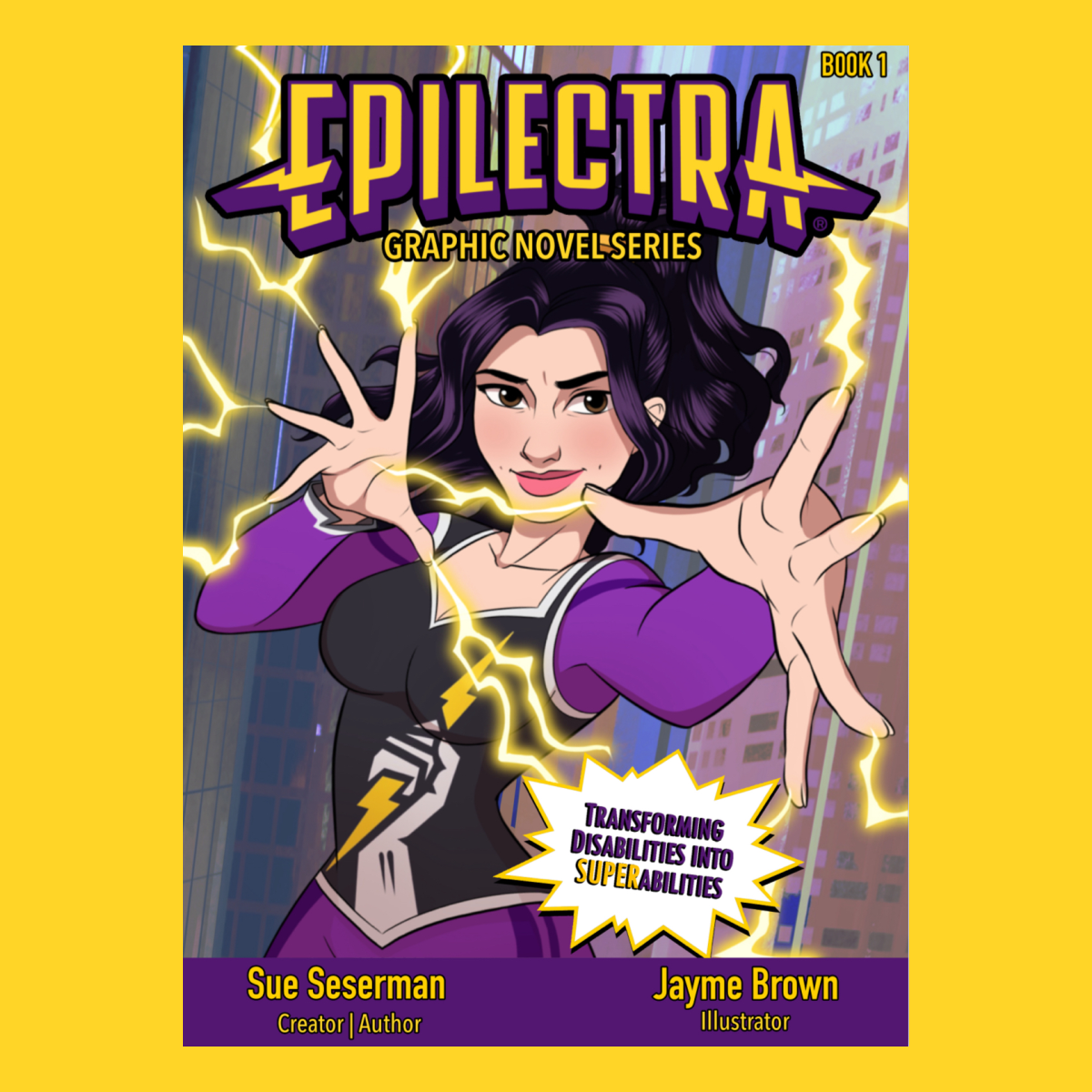
When the Pandemic hit, Sue had to stop volunteering. But she couldn’t stop thinking about her patients. She wanted to change their mindset from one of “I can’t” to one of “I can.” So, she created a real (albeit fictional) superhero with epilepsy that she transformed into a “superability” to make the world a better place. This was the origin of Epilectra. Over the next few years, Sue developed an entire team of superheroes with different disabilities and superabilities around Epilectra to create a superhero team – Team SEEZ for Support & Empower Everyone Zealously, as well as several adversaries and stories. By the end of the Pandemic, Epilectra Book 1 and Epilectra Book 2 were written, and each Book was filled with three complete Stories. Epilectra Book 1 holds Story 1: SEEZ ation, Story 2: Up on the Roof, and Story 3: River Rager. Epilectra Book 2 holds Story 4: Virulant’s Virus, Story 5: Neuron Navigator, and Story 6: The Dragon from Shang Chai.
If you let it, disability can make you stronger, more focused, more engaged, more sensitive, and more creative.
The mission of Epilectra is twofold: Disability Empowerment and Stigma Elimination. Sue strongly believes that, even with a disability – and maybe even because of it – one is capable of both having and reaching their dreams. Sue hopes Epilectra will help people with disabilities understand that they have real superpowers and are a force to be reckoned with. People should also understand that they have a vast team of support backing them. Because Seserman’s disabilities are “invisible,” she’s been networking with and leaning on the Invisible Disabilities Association for years. IDA has been there for her to answer questions, provide resources, to offer reassurance.